South Berkeley Office · Part 1 of 2

Alex Pell
Owner, Beyond Green Construction · 5 min read
From the early 1900s on, the barrier behind a wall’s siding was black tar paper: asphalt-soaked felt in 3-foot rolls. It went on with staples, but the asphalt sealed around each one. In the early 1980s, house wrap like Tyvek arrived, sold as a big step forward: plastic sheets in 9-foot rolls, stapled off with hundreds of holes per piece, and plastic doesn’t seal around a staple. A liquid applied WRB is a water-resistive barrier you roll or spray onto the sheathing, so there are no seams to tape and no staples punched through it. On a detached office and guest room in South Berkeley, we skipped the staples.
Why old houses never rotted
Old-school builders who swear by building paper have a point. A house built a hundred years ago leaked air everywhere, so when water got into a wall, it dried out before it could do much harm. Then we started insulating walls and sealing them up, and they lost that escape route. Coastal British Columbia found out what that costs in the 1990s: wood-frame condos rotting and growing mold within a few years of being built, about $4 billion in repairs across more than 900 buildings. That’s when building science got serious about walls. Shed the water, stop the air, and let the wall dry. A liquid-applied WRB is where that thinking ends up.
Liquid applied WRB vs. house wrap and building paper
A sheet barrier, paper or wrap, is only as good as its laps and its staples. House wrap also doesn’t love the sun: DuPont says Tyvek HomeWrap should be covered within about four months of going up.
A liquid-applied barrier is one continuous skin, with no laps and no staples. Prosoco’s R-Guard line came along in the 2000s, and Cat 5 is part of it. It’s a silyl-terminated polymer, which Prosoco describes as the best of silicone and polyurethane combined. In plain terms, it’s close to liquid rubber. It stays flexible after it cures, and it seals around fasteners driven through it. Prosoco rates it for up to 12 months in the sun before the siding has to go on.
It also breathes. Cat 5 tests at 10 to 14 perms (ASTM E96), so it stops liquid water and air but lets water vapor out. That’s the lesson of the old houses, built into the coating: a wall that gets wet has to be able to dry.
What went on the walls in South Berkeley
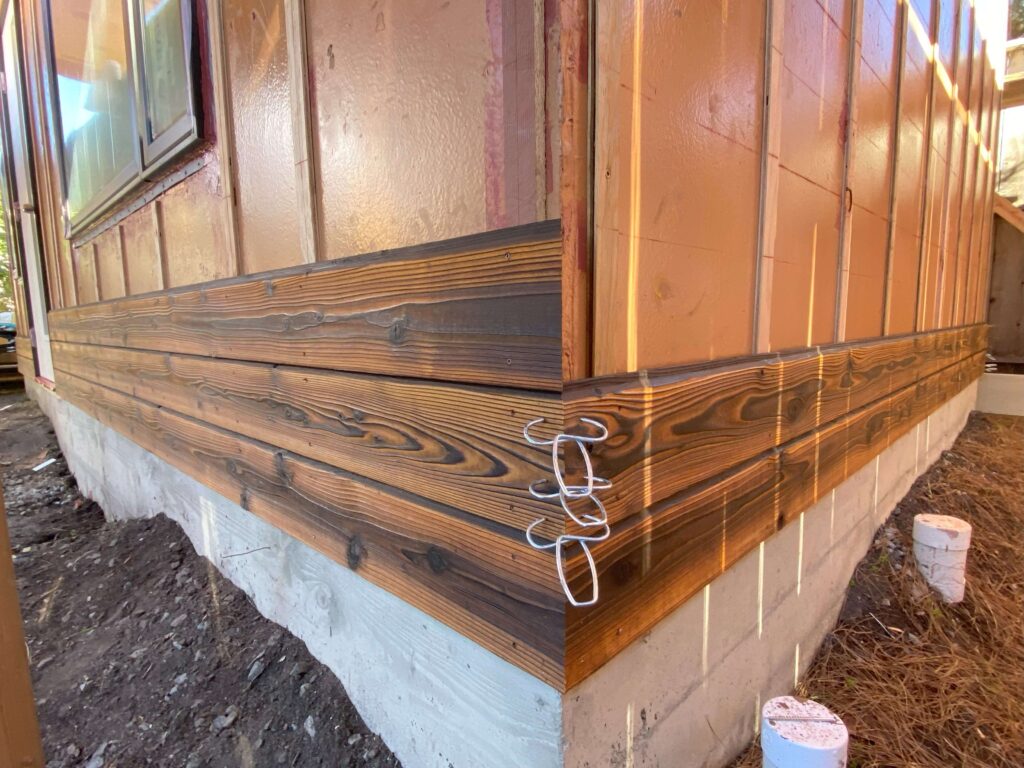
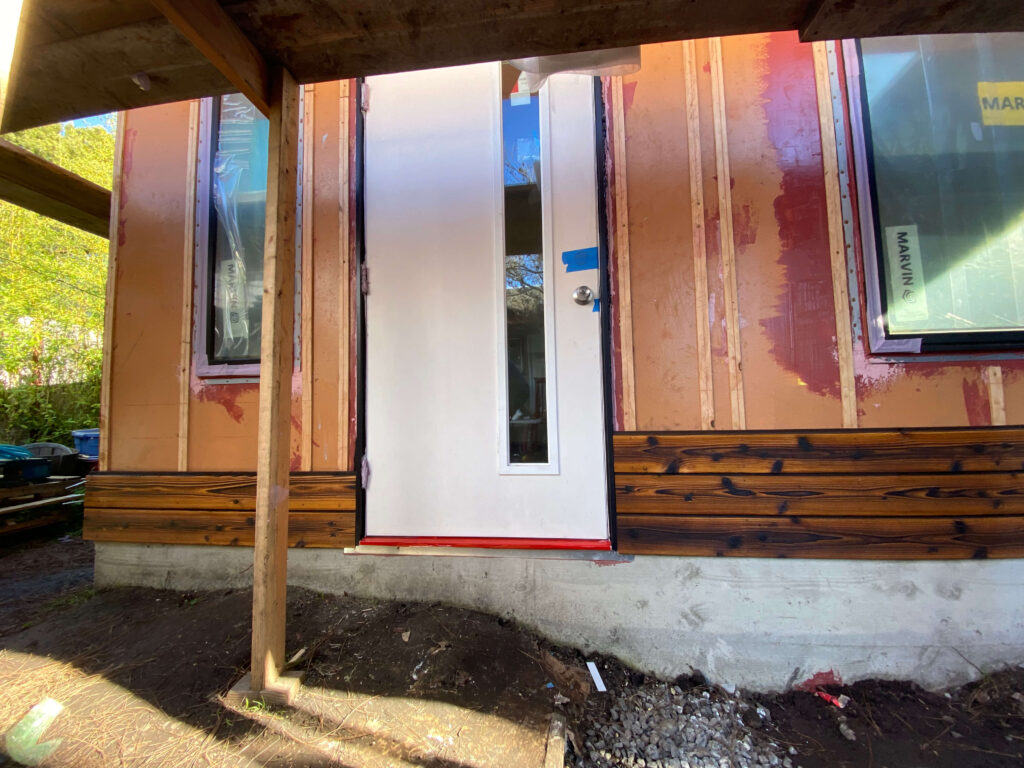
The building is sheathed in 1/2-inch Structural 1 plywood. Prosoco’s system goes on in three parts. First, Joint & Seam Filler, a pink, fiber-reinforced paste, fills the gaps between sheets and anywhere two materials meet. Then we rolled Cat 5 over everything, until the whole building was one skin. Last comes FastFlash, a red, gun-grade sealant made to bond with Cat 5. It wraps the window and door openings and seals the window flanges to the wall, in place of tape.
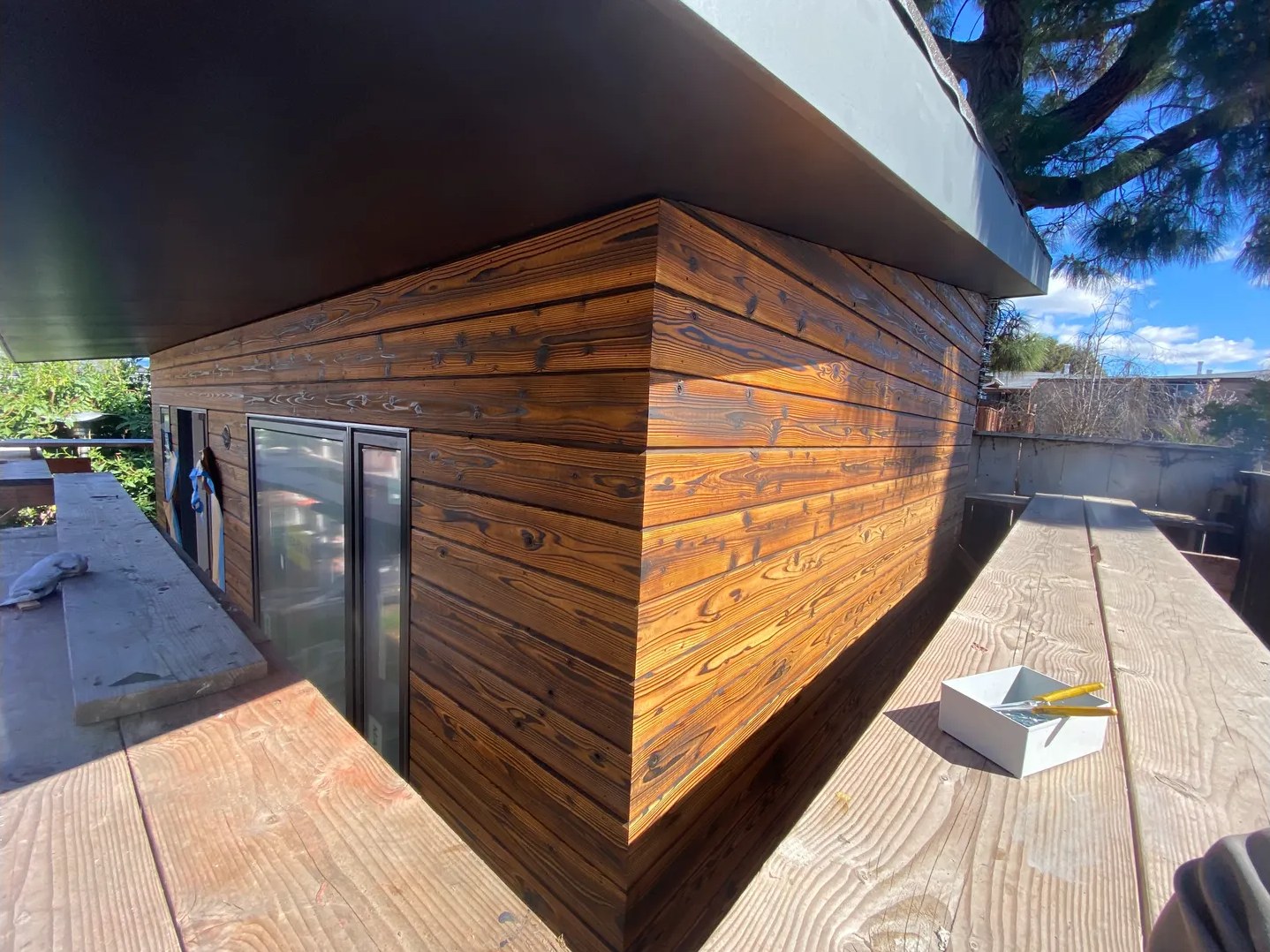
The siding is Japanese flamed cedar, run horizontally over a rainscreen: 3/8-inch plywood furring strips that hold the boards off the wall, so water can drain and everything behind the siding can dry. That deserves its own post. What matters here is that every furring strip is screwed on through the barrier. With house wrap, each of those screws is another hole. With Cat 5, the coating closes around every one.
What it costs
Liquid costs more than house wrap: about 25 to 40 percent more on that line, depending on labor, which is most of the difference. Detailing every seam and opening and rolling three products onto a wall takes longer than unrolling a sheet. Now look at the whole job. On a building like this, the weather barrier is about 4 percent of the total cost. Going liquid adds about 1 to 1 1/2 percent to the job.
What I’d tell anyone choosing a weather barrier
- Do the cost math on the whole job, not the line item.
- If anything gets fastened through the barrier after it goes on, like furring, trim or siding, ask what seals those holes.
- Ask how long the barrier can sit uncovered, and how long your schedule might actually leave it there.
- Whatever you choose, the wall has to be able to dry.
The verdict
Prosoco is the Cadillac of weather barriers, and there’s no job I wouldn’t use it on, unless the budget can’t carry it. During the build, the walls can take weather the day they’re coated and wait out a slipped schedule. For the life of the building, there’s one continuous, flexible skin behind the siding, every screw sealed, and a wall that can still dry out. That’s worth 1 to 1 1/2 percent of the job.
We build walls this way on our home renovations whenever the budget allows.
FAQ
What is a fluid-applied weather barrier?
A coating, rolled or sprayed onto the wall sheathing, that cures into one continuous membrane. It does the job of house wrap or building paper, keeping out liquid water and air while letting vapor escape, without seams or staples. On our South Berkeley job, it was Prosoco’s R-Guard Cat 5.
Is a WRB the same as house wrap?
House wrap is one kind of WRB. WRB stands for water-resistive barrier, the layer behind the siding that keeps rain off the sheathing. Building paper, house wrap, coated sheathing panels like ZIP and liquid-applied coatings are all WRBs.
Can I use roofing paper instead of house wrap?
The building code accepts No. 15 asphalt felt as a water-resistive barrier, and plenty of sound walls have been built with it. In our experience it works when it’s lapped carefully, but every lap and fastener is a weak point, which is why we go liquid when the budget allows.
How long does a liquid-applied WRB last?
We plan on it lasting the life of the building, which means it should never need replacing. Behind the siding it’s out of the sun, and cured rubber kept in the dark has very little to break it down. Prosoco says FastFlash, the flashing in the same system, has been independently proven to perform for 20 years.
Why don’t all builders use a liquid-applied WRB?
Mostly cost. It runs 25 to 40 percent more than house wrap on that line, most of it labor. On the whole job, in our experience, the difference is about 1 to 1 1/2 percent.
More from this job
South Berkeley Office
- Prosoco: the best in-wall waterproofing (you’re reading it)
- ZIP sheathing: what is it, and why do you want it under your roof?
About the author
Alex Pell
I grew up in the Colorado mountains, the kid rebuilding CD players and racing a dog sled I’d built myself. (My great-grandfather held more than 100 patents; it runs in the family.) I was on my first jobsite at 17, building straw bale homes, then apprenticed as a carpenter, electrician and plumber, and started Beyond Green in 2017. Here I write about what’s behind the finished photos: the calls forced by budget, code and the site, and the ones that come from 25 years of seeing what holds up and what doesn’t.
The project
South Berkeley Office
Detached backyard office and guest room in South Berkeley
Facing a decision like this on your own project?
Talk it through with Alex on a free 15-minute call.
Book a 15-minute call (510) 239-7589