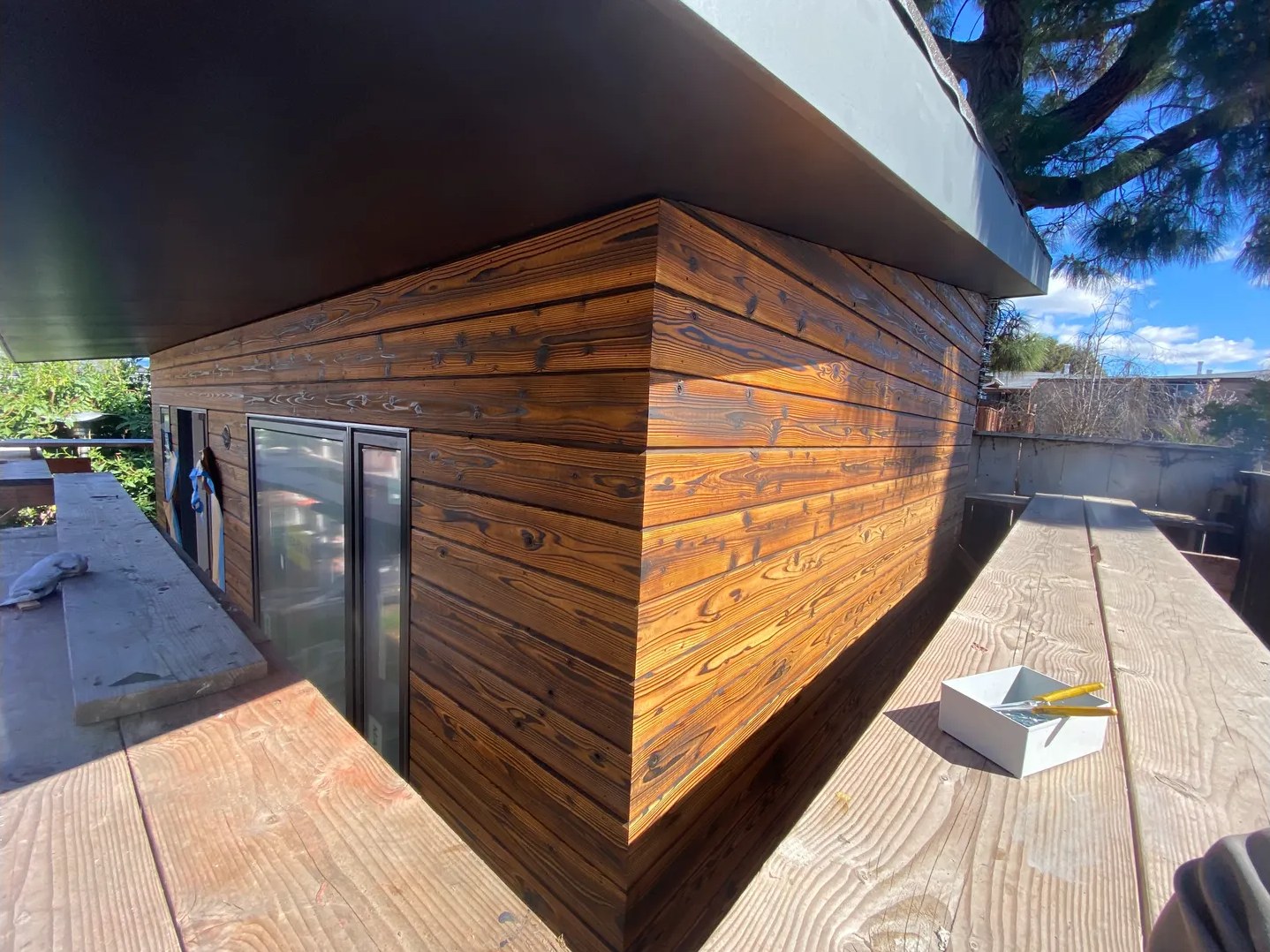
South Berkeley Office · Part 2 of 2

Alex Pell
Owner, Beyond Green Construction · 6 min read
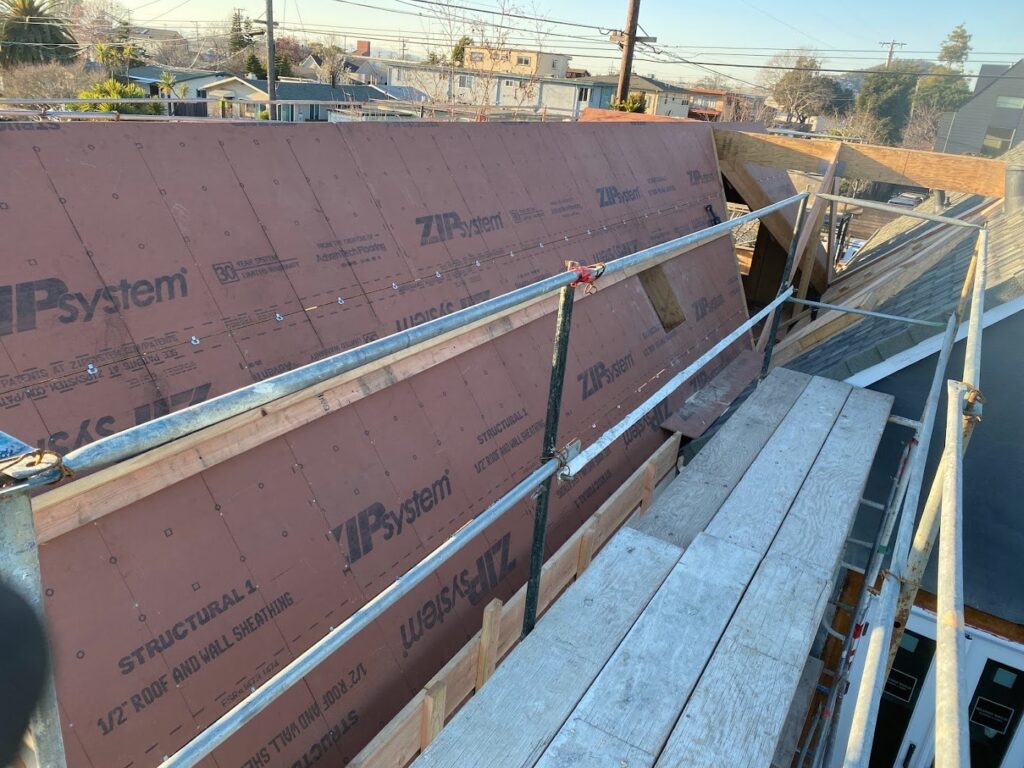
The last strip of tape went down on the roof at the end of October 2025. The building was a detached office and guest room in South Berkeley, framed and full of my tools, with nothing on the roof but ZIP sheathing and tape. A few days later I left for vacation. Then the storms came: two big ones, early in the season, that nobody saw coming. I was gone 17 days. When I got back, there wasn’t a single drop inside.
Seventeen days, two storms
The building sits behind a house in South Berkeley, with a shed roof at 2:12, the bare minimum slope for shingles. Every seam on the roof deck was taped, and I also ran tape over the fascia for extra durability. No roofing of any kind. That was all that was on it while I was gone.
Not a drip line on the subfloor, not a wet tool. Just a dry building, waiting for its roofer.
Buildings get rained on
Here’s the part most people don’t think about: a building gets rained on before it’s closed up. Sometimes it’s bad luck with the weather, and sometimes it’s just normal sequencing. The framing is done, the roofer is booked weeks out, and the forecast doesn’t care.
With a roof deck that sheds water on its own, that gap stops being a problem. The framing stays dry, the schedule has room to breathe, and nobody is up on a wet roof in the dark wrestling a tarp. That flexibility is worth a lot during a build.
What is ZIP sheathing?
ZIP sheathing is a structural OSB panel that does the same job plywood does on a roof or a wall, with the weather barrier built onto its face at the factory. Huber, the company that makes it, sells it with its own tape for the seams. Once the seams are taped, the deck is the barrier. There’s no separate layer to roll out and staple down.
Huber rates the taped panels to sit exposed for up to 180 days. On walls, it’s a code-recognized water-resistive barrier on its own.
ZIP sheathing vs. house wrap and building paper
The way most buildings still go up: plywood first, then a separate sheet over it. On walls that’s house wrap, the white Tyvek you see on every job. On roofs it’s old-school building paper.
The problem is that the sheet is a separate layer, and a jobsite is hard on it. It’s stapled on, so it starts out full of holes. Then the wind gets under it, ladders and lumber drag across it, and other trades cut into it. By the time the siding or the roofing goes on, it has a million holes in it, and it doesn’t seal itself back up.
With ZIP, there’s no sheet to tear. The barrier is the face of the panel. The weak points are the seams, and the seams are taped.
The building science: water out, air out, room to dry
A building’s skin has three jobs, and getting all three right is what makes a building last. ZIP does all three in one layer.
- Keep liquid water out. Huber tests the panels for water penetration and for wind-driven rain at 100 mph, and they pass both. It’s rated to the same code standard as the building paper it replaces.
- Keep air out. On walls, taped ZIP is also an air barrier. That matters more than most people think: air leaking through a wall carries moisture with it, and when warm, damp air hits a cold surface inside the wall, it turns back into water. A tight skin is where a dry, efficient wall starts.
- Let the wall dry. The face of the panel still lets water vapor through (Huber rates it at 12 to 16 perms), so any moisture that does get into the wall has a way out. A skin that keeps water out but traps it in is how walls rot.
None of this shows up on move-in day. It shows up 20 years later, in framing that’s still dry and sound.
The tape is the system
The tape is what makes it work. ZIP’s tape uses an acrylic adhesive, a totally different family from the flashing tapes builders grew up with. It’s pressure-activated, so it gets rolled down hard with a roller, and Huber says the bond gets stronger over time. In my experience, once it’s down, it doesn’t come off.
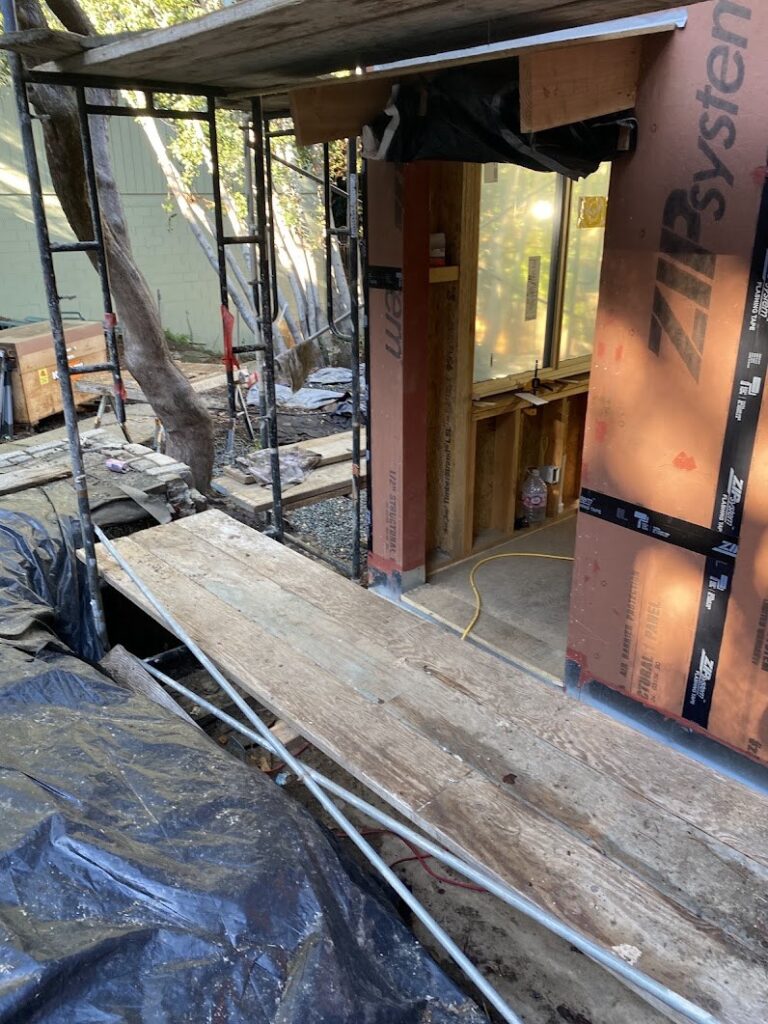
Running the tape and rolling it right is a skill, and it’s a new one. That’s a big part of why some old-school builders still don’t like ZIP: they haven’t worked with it, so they don’t trust it. This roof is my answer to that.
Why ZIP became the standard on premium builds
ZIP has become the standard on the jobs where quality matters most, and the reasons are the ones above. The barrier is bonded to the panel, so there’s no separate sheet for the job to tear. Sheathing and weather barrier go on in one step instead of two. The building stays dry while it waits for roofing and siding. And the finished building has a better barrier under it for as long as it stands. Builders who care about a truly high-end result use it.
What it costs
Less than you’d think. The panels cost about the same as plywood plus house wrap or building paper. Taping every seam is a little more labor, but not much.
It’s a better roof long after the shingles go on
Keeping a build dry is the everyday win. The bigger one is the roof you end up with.
It’s your roof. The shingles are only the first layer. What sits under them is what keeps the water out when a shingle blows off or a storm drives rain under the edges. A really good weather barrier under the roofing is what a long-lasting roof is built on. With ZIP, that barrier is bonded to the deck, and its seams are sealed with a tape that stays put.
What I’d tell anyone planning a roof
- Plan on rain before the building is closed up. It’s part of construction.
- Ask what’s going under your roofing, not just what’s going on top.
- A barrier bonded to the deck beats a separate sheet the job can tear.
- The tape is the system. Every seam gets taped and rolled down by someone who knows how.
- It costs about the same as plywood and house wrap, with a little more labor.
The verdict
Buildings get rained on before they’re closed up. ZIP is how I make sure that doesn’t matter: the framing stays dry, the schedule has room, and when the shingles finally go on, there’s a sealed deck under them for the life of the roof. Seventeen days, two storms and not one drip is the proof.
If you’re planning a backyard building of your own, start with our custom ADU page.
FAQ
What is ZIP sheathing?
ZIP sheathing is a structural roof and wall panel made by Huber with the weather barrier built onto its face. Its seams are sealed with Huber’s own tape, so the sheathing itself becomes the barrier, without a separate layer of house wrap or building paper.
Do you need house wrap over ZIP sheathing?
No. On walls, taped ZIP sheathing is a code-recognized water-resistive barrier on its own, so house wrap over it isn’t needed. What matters is that every seam is taped and rolled down right.
Is ZIP sheathing worth it?
In our experience, yes. It costs about the same as plywood plus house wrap or building paper, with a little more labor for the tape. In return, the building stays dry before it’s closed up, and you get a barrier bonded to the deck instead of a sheet the job can tear.
Why don’t all builders use ZIP sheathing?
It’s a different system from plywood and house wrap, and running and rolling the tape takes skill. In our experience, the builders who don’t like it are mostly the ones who haven’t worked with it yet.
More from this job
South Berkeley Office
- Prosoco: the best in-wall waterproofing
- ZIP sheathing: what is it, and why do you want it under your roof? (you’re reading it)
About the author
Alex Pell
I grew up in the Colorado mountains, the kid rebuilding CD players and racing a dog sled I’d built myself. (My great-grandfather held more than 100 patents; it runs in the family.) I was on my first jobsite at 17, building straw bale homes, then apprenticed as a carpenter, electrician and plumber, and started Beyond Green in 2017. Here I write about what’s behind the finished photos: the calls forced by budget, code and the site, and the ones that come from 25 years of seeing what holds up and what doesn’t.
The project
South Berkeley Office
Detached backyard office and guest room in South Berkeley
Facing a decision like this on your own project?
Talk it through with Alex on a free 15-minute call.
Book a 15-minute call (510) 239-7589