Montclair Bathroom Remodel · Part 3 of 3

Alex Pell
Owner, Beyond Green Construction · 7 min read
A low-maintenance shower starts with less grout. Two regrets have come up with clients over and over through the years. They went light on the grout color, or they went with a small tile or a mosaic. Both are grout regrets. On the Montclair bathroom we finished this summer, the shower floor doesn’t have any.
Grout is the part you keep cleaning
Tile is easy to live with. It’s hard, it’s smooth, and it wipes clean. Grout is the opposite. It sits just below the face of the tile, soap and hard water settle into it, and in a shower it’s where mildew starts. Over the years, the grout is what clients end up scrubbing.
On color, the complaint I hear is light grout: it’s hard to keep clean over the years. Darker grout is more forgiving, though most people don’t want to go all the way to black. The Montclair shower is grouted in a gray.
The other regret is tile size, and it’s really the same problem. The smaller the tile, the more grout comes with it. Mosaics are the pinnacle of the problem.
The job: a family bathroom in Montclair
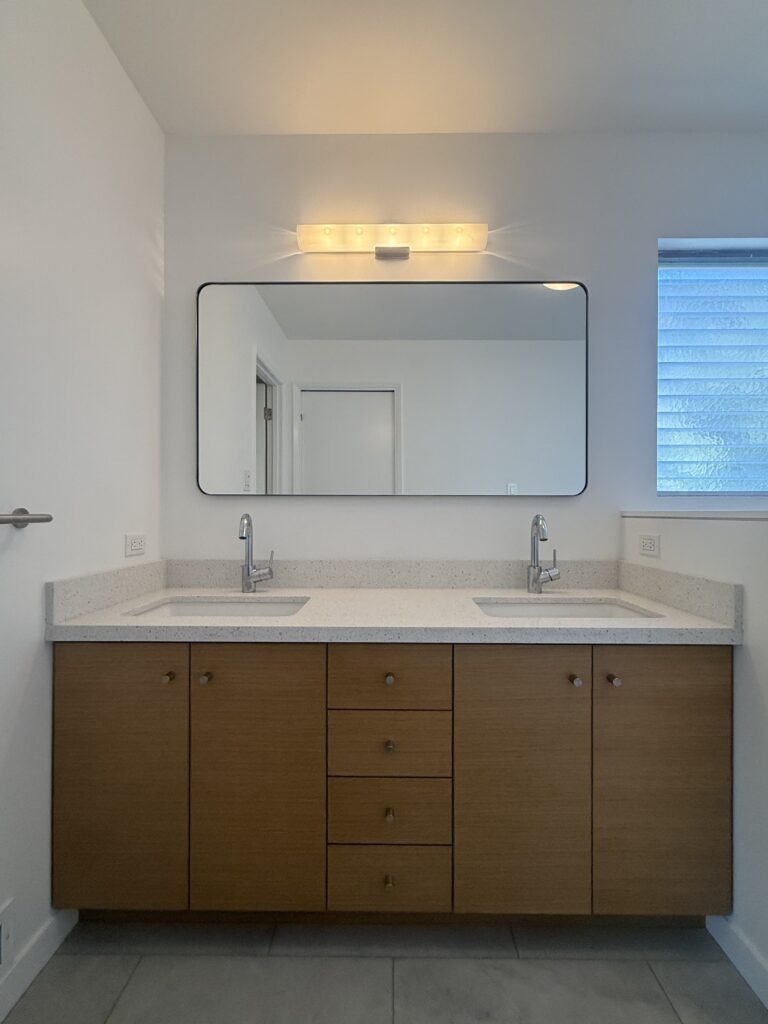
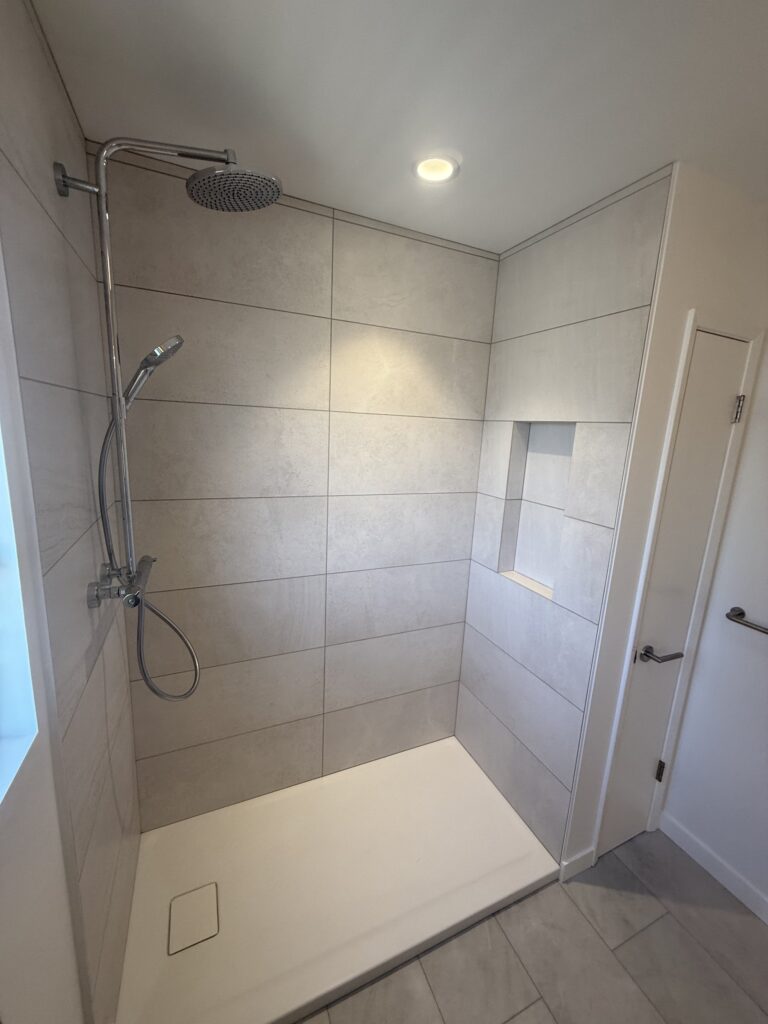
This was the third-floor bathroom on our Montclair job, about 75 square feet, finished in August 2026: a full gut, same layout, for a family of three who lived in the house the whole time. The old cast-iron tub came out and a shower went in its place, with the drain right where the tub’s had been. The owners picked a large-format tile for the walls, and the floor is a one-piece tray. Between the two, there’s very little grout in that shower, and none underfoot. Families care how a bathroom cleans as much as how it looks.
A shower tray instead of a tiled floor
The shower floor is where grout has the hardest life. Water sits there, everything rinses down to it, and because a tiled shower floor has to slope to the drain, it’s usually built from small tile, often a mosaic.
At Montclair, the floor is a one-piece 60-by-30 tray from MTI Baths, in their DoloMatte, a matte white solid surface. There are no grout lines in it at all. MTI makes it from a polymer blended with ground minerals and rates it non-porous and resistant to scratches and stains. A flange on three sides runs up the walls behind the tile, so water running down the wall ends up in the tray. It also has a clean, modern look of its own, which is the look most of our clients come to us for.
Big tile on the walls
With large-format tile on the walls, there just isn’t that much grout on the wall.
Big tile usually costs less to install, too. Fewer pieces means less time setting and less time grouting. Small tile and mosaics take more labor for every square foot, so the look with the most grout is also the one that costs more to put in. Tile is one of the finishes that decides where you land in a bathroom remodel’s cost range.
Large tile does ask one thing: it has to go on flat. Across two feet of tile, a slight hump in the wall, or a tile that settles a hair while the thinset cures, shows up as one edge sitting proud of the next. The standard for getting it right is a leveling clip system: clips in the joints hold neighboring tiles at the same height until the thinset sets. Not every tile setter uses them. The ones doing high-end work do, and on our jobs it’s how large tile goes up.
A grout that never needs sealing
For the grout that’s left, my rule is simple: don’t use a grout that needs to be sealed. Ordinary cement grout is porous, so it gets sealed, the sealer wears off, and then it needs sealing again. You’re forever chasing it.
There are two good ways out. The classic one is a full epoxy grout. It isn’t porous, so it doesn’t soak up stains and never needs sealing. It comes in separate parts that get mixed on site.
The other is a pre-mixed grout with epoxy’s benefits. At Montclair we used Laticrete SPECTRALOCK 1, in a gray called Stormy Grey. Laticrete says it performs the same as their epoxy grout, without the epoxy resins. It never needs sealing, it’s stainproof in homes, it cures to an even color with no blotchiness, and it fights mold and mildew.
Either one does the job. What matters is that the grout in your shower never needs to be sealed.
No grout at all: plaster made for wet walls
For clients who don’t want to deal with grout lines at all, there’s another route to low-maintenance shower walls, and it’s becoming popular: plaster made for showers. It goes on as one continuous surface, corner to corner, with no joints to clean. There are three kinds worth knowing, and a maker I’d look at for each.
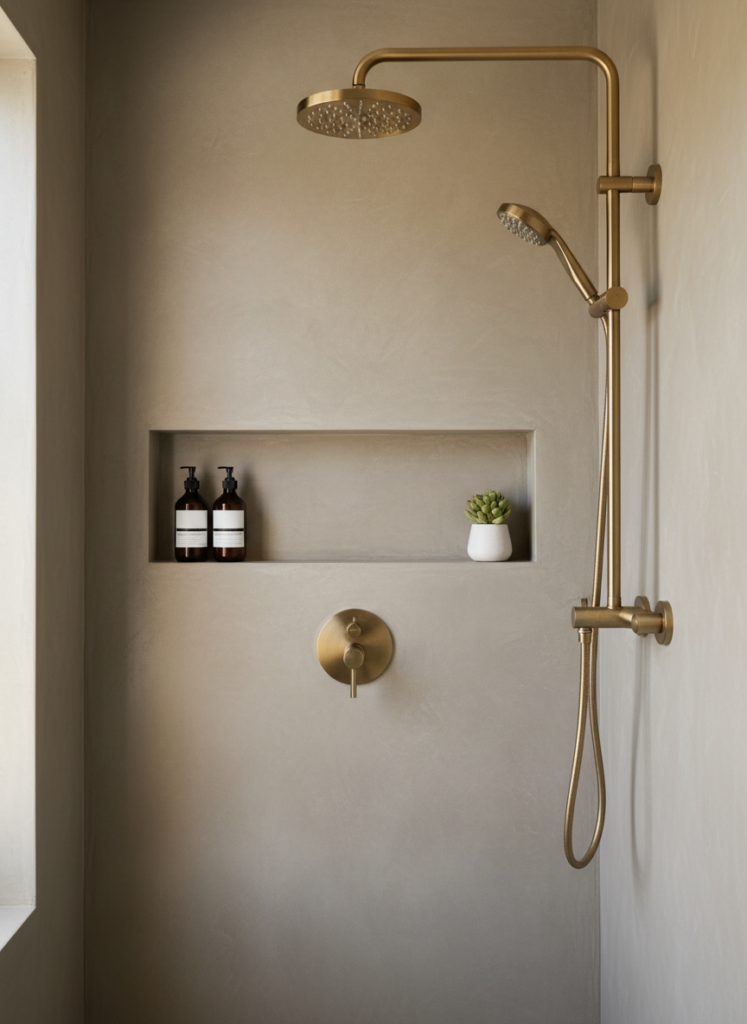
Venetian lime plaster: Vasari. Lime plaster troweled on in thin layers over a liquid waterproofing membrane, then sealed with Vasari’s mineral sealer and wax. Lime is naturally resistant to mold and mildew.
Tadelakt: Color Atelier. The Moroccan method: lime plaster compressed and burnished until it’s dense and silky-smooth, then sealed so water runs off, traditionally with olive oil soap, in Color Atelier’s system with wax. They make theirs in the US as a complete shower system.
Microcement: Duraamen. A thin, polymer-modified cement coating troweled over backer board, reinforced with mesh and protected under tough resin topcoats. Their Skraffino system is durable and versatile, with more of a concrete look, though it doesn’t age into the soft patina a lime plaster develops. Duraamen has a store in Hayward.
Three things to know before you choose one:
- It isn’t the waterproofing. Like tile, plaster goes over a waterproof membrane. The plaster is the finish.
- Lime plasters are for walls. Most of their makers don’t recommend them on a shower floor, so plaster walls pair well with a one-piece tray.
- No grout doesn’t mean no care. Plaster wants gentle, pH-neutral cleaners, never bleach or vinegar, and a fresh coat of wax or sealer every so often.
These are complete systems, membrane to topcoat, and they’re systems we can install. For a client who would rather wipe down a wall than scrub grout, plaster is a really good option.
How to build a low-maintenance shower
- Think about the grout, not just the tile. The smaller the tile, the more lines you’ll be cleaning.
- Lean darker on grout. Light grout is hard to keep clean, and most people stop short of black.
- If you love a mosaic, know what comes with it. It’s the most grout you can put in a shower.
- Ask about a one-piece tray for the shower floor. The floor is where grout has the hardest life.
- On large tile, ask whether your tile setter uses leveling clips. Big tile has to go on flat.
- Use a grout that never needs sealing. A full epoxy, or a pre-mix built to perform like one. Sealing is a job you never finish.
- If you don’t want grout at all, ask about plaster made for wet walls. And plan on its care routine.
The verdict
On the Montclair shower, the modern look and the easy cleaning came from the same place: very little grout. A one-piece tray on the floor, big tile on the walls, and a grout that never needs sealing in the lines that are left. For a client who wants none at all, plaster walls on a tray get there. The less grout you build into a shower, the less of it you’ll scrub, and the less you’ll have to regret about it later.
If you want a modern bathroom that’s easy to keep clean, start with our bathroom remodeling page.
FAQ
What is the best material for shower walls without grout?
For no grout at all, plaster made for wet walls: a Venetian lime plaster, a tadelakt or a microcement, over a waterproof membrane. It needs gentle cleaners and a fresh coat of wax or sealer from time to time. In our experience, if you’d rather skip that routine, large-format tile with a grout that never needs sealing leaves very little grout to clean.
Are groutless showers more expensive?
Not necessarily. Large tile usually costs less to install than small tile or mosaic, because there are fewer pieces to set and grout. In our experience, a one-piece tray or a plaster finish is a finish choice like the tile: it moves where you land in a bathroom’s budget, while the layout of the bathroom sets the range.
What type of shower material is easiest to clean?
In our experience, smooth, non-porous surfaces with no joints. A one-piece solid-surface tray like the one in our Montclair shower has none, and large tile with a grout that never needs sealing comes close. Plaster has no joints either, but it wants gentle cleaners and a fresh coat of wax or sealer now and then.
Does shower grout need to be sealed?
Ordinary cement grout does, and the sealer keeps wearing off, so you end up resealing it for as long as you own the shower. In our experience, it’s better to use a grout that never needs sealing: a full epoxy grout, or a pre-mixed grout built to perform like epoxy, such as the Laticrete SPECTRALOCK 1 we used at Montclair.
More from this job
Montclair Bathroom Remodel
- We gutted a bathroom across the hall from the owner’s office
- Changing the layout drives bathroom remodel cost more than your finishes
- The easiest shower to keep clean has the least grout (you’re reading it)
About the author
Alex Pell
I grew up in the Colorado mountains, the kid rebuilding CD players and racing a dog sled I’d built myself. (My great-grandfather held more than 100 patents; it runs in the family.) I was on my first jobsite at 17, building straw bale homes, then apprenticed as a carpenter, electrician and plumber, and started Beyond Green in 2017. Here I write about what’s behind the finished photos: the calls forced by budget, code and the site, and the ones that come from 25 years of seeing what holds up and what doesn’t.
The project
Montclair Bathroom Remodel
Third-floor bathroom, full gut
Facing a decision like this on your own project?
Talk it through with Alex on a free 15-minute call.
Book a 15-minute call (510) 239-7589