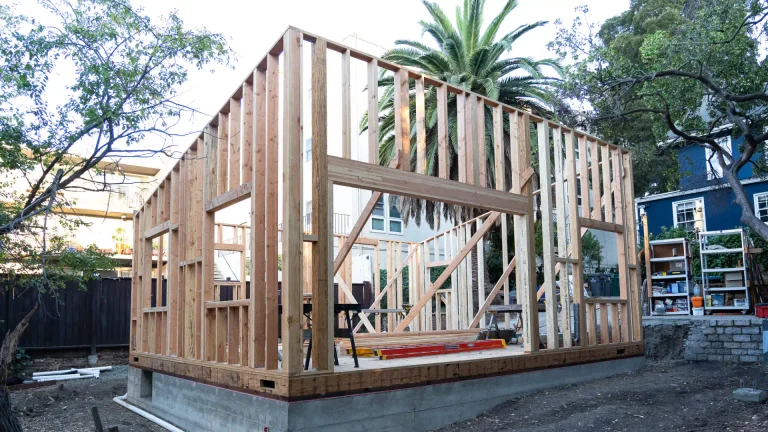
Adams Point ADU · Part 1 of 4

Alex Pell
Owner, Beyond Green Construction · 6 min read
The short answer
On a PG&E service upgrade, if the utility tells you the new service has to go on the front of the house, ask them which Greenbook section requires it. On our Adams Point ADU in Oakland, PG&E said no twice. First to putting the new 400-amp equipment on the side, then to bringing the drop in on the side. Both times we asked for the rule, and there wasn’t one. Approval took five months.
The job: why this house needed 400 amps
The project is a new backyard ADU in Oakland’s Adams Point, and it’s all electric. The main house was already large, with its own informal ADU. And the client wanted a dedicated EV charger for each unit.
That’s three living spaces and two cars on one service. It meant a new 400-amp service, and 400-amp equipment takes up a lot of wall.
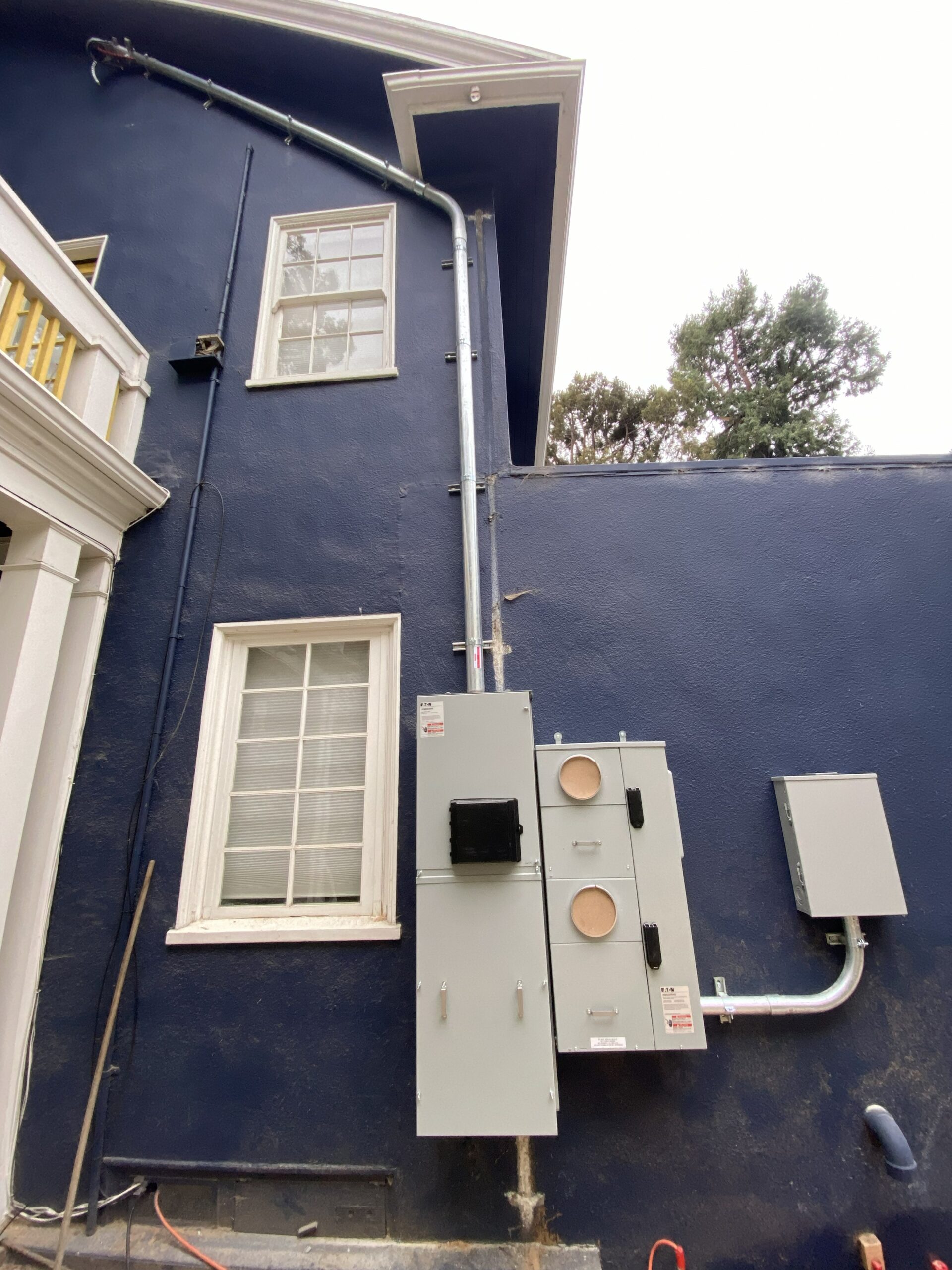
The front of this house had absolutely no place to put it. The only wall that worked was the side.
Round one: PG&E said you can’t put it there
When we brought PG&E the side location, the answer was flat: you literally can’t put it there. They wanted the service on the front, where they’d assumed it would fit.
It didn’t fit. So we asked the question that turned the whole thing: what, specifically, requires the front?
The answer was nothing. We went back to the letter of PG&E’s Greenbook and Oakland code. Neither had enforceable language keeping the service on the front. PG&E can enforce the Greenbook. It can’t make up its own code for your job.
That got the equipment approved on the side.
Round two: PG&E wanted the drop at the front
Once PG&E agreed the equipment could go on the side, they told us the drop still had to come in at the front, on the street side.
Bringing the drop to the front is best practice, and it’s where we’d put it if we could. But when I pressure-tested it, it wasn’t a requirement either. What the Greenbook does limit is how long the drop can be.
On this house, the front wasn’t reachable. A big exterior chimney was in the way, and routing the conduit around it would have blown past the Greenbook’s 270-degree bend limit.
So the weatherhead had to go on the side, over the balcony. We did a separate drawing set for PG&E, including a full 2D elevation of the side of the house, and checked the attachment against every Greenbook rule. It passed all of them. It took five months from the first no to full approval.
Making the side work: the drop, the bends, the balcony
Winning both arguments was half of it. The side location still had to work in the field, and it came with three constraints.
The drop
The Greenbook limits how long the drop can be, so the weatherhead had to land on the side close enough for PG&E’s drop to reach it. Getting that position right was the trickiest part of the layout.
The bends
The Greenbook caps the conduit at 270 degrees of total bend. That limit is what ruled out the front, and the side route had to stay under it too.
The balcony
The weatherhead ended up on a wall with a balcony below it. PG&E only requires service wires to be 8 feet above an elevated walking surface like a balcony (Greenbook doc. 022169). We put ours at 11.
Eight feet meets the rule. But picture live service lines 8 feet over a balcony where people throw parties: string lights, a patio umbrella, someone reaching up. That doesn’t feel safe enough. The minimum is the floor, not the design target, so we went 3 feet higher.
What I’d tell anyone planning a PG&E service upgrade
- Ask for the section. Every time the utility says no, ask which Greenbook or code section requires it. We had to ask twice on this job.
- Draw it for PG&E separately. Their approval runs on its own drawings and its own clock, so plan time for it.
- Count your bends before you pick the spot. A location that looks fine on the wall can fail on conduit geometry. Here, one chimney ruled out the front.
- Treat minimums as minimums. Set clearances for how the space will actually be used, not just what passes.
The verdict
The side of the house was the only place this service could go, and it was worth the fight.
Planning an ADU or an all-electric upgrade in Oakland? The electrical service is one of the first things we sort out in pre-construction.
FAQ
Can PG&E require my meter to be on the front of the house?
In our experience, PG&E can enforce what’s written in the Greenbook and local code, not a preference. On our Adams Point job, PG&E first said the service had to stay on the front. Nothing enforceable required it, and the side location was approved.
Does the PG&E service drop have to come in at the front of the house?
Front is best practice, but in our experience the Greenbook doesn’t require it. It does limit the drop’s length. At Adams Point, an exterior chimney made the front unreachable within the 270-degree conduit bend limit, so PG&E approved a side attachment.
Why would an ADU project need a 400-amp service?
The load adds up fast. This job had an all-electric ADU, a large main house with its own informal ADU, and a dedicated EV charger for each unit. That called for a new 400-amp service.
How much clearance does PG&E require above a balcony?
PG&E only requires service wires to be 8 feet above an elevated walking surface like a balcony (Greenbook doc. 022169). We installed ours at 11 feet, because 8 feet over a space people gather in isn’t enough margin.
How long does a PG&E service upgrade take?
Longer than most people plan for. On our Adams Point ADU, PG&E’s approval alone took five months, with two rounds of comments and a separate drawing set that included a full elevation of the side of the house. Their review runs on its own drawings and its own clock, so we plan time for it from the start.
More from this job
Adams Point ADU
- PG&E said the meter had to go on the front (you’re reading it)
- Makeup air: the high-CFM hood you want needs one
- Below grade: the sewage ejector and the French drain (coming)
- The pump alarm we built (coming)
About the author
Alex Pell
I grew up in the Colorado mountains, the kid rebuilding CD players and racing a dog sled I’d built myself. (My great-grandfather held more than 100 patents; it runs in the family.) I was on my first jobsite at 17, building straw bale homes, then apprenticed as a carpenter, electrician and plumber, and started Beyond Green in 2017. Here I write about what’s behind the finished photos: the calls forced by budget, code and the site, and the ones that come from 25 years of seeing what holds up and what doesn’t.
The project
Adams Point ADU
New backyard ADU, all-electric
Facing a decision like this on your own project?
Talk it through with Alex on a free 15-minute call.
Book a 15-minute call (510) 239-7589